
Summer Reading List
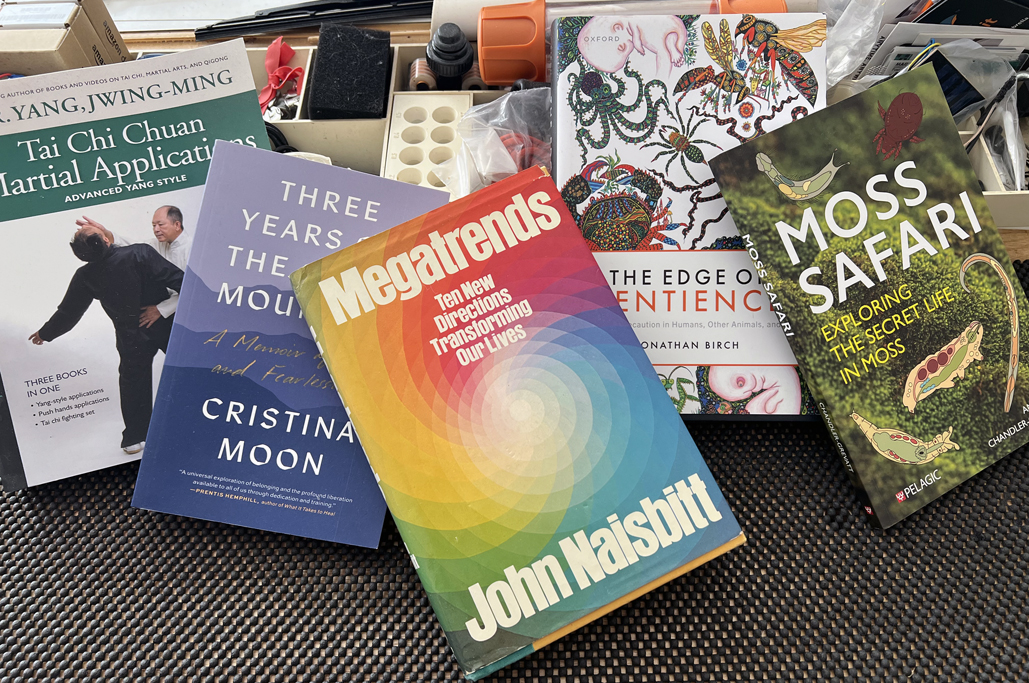
The summer of 2026 is fast approaching, and we have a few very interesting books on our reading list!
Four of them are new to us, but one of them we are re-reading. Why? Because it’s worth doing, especially since many of its predictions have come true.
The List
- Three Years On The Great Mountain by Cristina Moon
- Tai Chi Chuan Martial Applications by Dr. Jwing-Ming Yang
- Moss Safari by Andrew Chandler-Grevatt
- The Edge of Sentience by Jonathan Birch
- Megatrends by John Naisbitt

We hope you enjoy these Summer Reading recommendations, be inspired, and have a great Summer. Drop us a note and let us know what you think of them.
Three Years On The Great Mountain
Training the body to train the mind is different than training them separately. Those of us who have trained in martial arts for some time know it takes good teachers, focus, and self-reflection to make substantive progress in such endeavors. Many start the journey, but few have the commitment, discipline, and focus to stay the course.
Three Years on the Great Mountain by Cristina Moon is a book about her journey, her training, and her evolution. We look forward to reading it.

Tai Chi Chuan Martial Applications
After studying Aikido for 20 years, one of our editors took some time off from his training with Sensei Gleason to study Tai Chi Chuan at a local school started by a student of Dr. Yang. Sensei Gleason studied with Dr Yang for many years and had incorporated aspects of Tai Chi Chuan into his Aikido teaching.
While some may think of Tai Chi as just flowing movements, it is, at its core, a form of martial art for close-quarter self-defense and combat. In order to manifest the energy of the Tai Chi movements properly in solo practice, it is important to visualize the opponent, the situation, and the response.
This book was written by Dr. Yang to share his knowledge, to illustrate the application of the movements, and how they may be applied in various situations. We look forward to incorporating his teachings into our daily practice.

Moss Safari
We would never go on a hunting safari, but a photographic one? Absolutely! Bagging the “Big Five” would be an amazing adventure of a lifetime.
This Summer, we plan to take the Summer off and go on a “Moss Safari” and bag a different kind of “Big Five”: Nematode, Rotifer, Tardigrade. Mite, and Gastrotrich.
They can be found within the mosses in the pots of our plants, on the stones and pavements out in the walkway, and living on the surfaces (roofs, walls, etc) out in the RainyDayGarden.
“…you just need a microscope, some moss, a slide and a cover slip. You only need to adjust the focus…”

The Edge of Sentience
AI has been all over the news this year. While some of us studied it in college and have been neck deep in it for almost a decade, its recent progress has been nothing but extraordinary. It really feels like a lot of things have converged, and are now in place for some very exciting–and to some, menacing–advancements to take place.
While some consider the advancements in AI to be just improvements in a “tool” we can use, others see it as a potential existential threat. The argument is that, unlike other significant advances, AI has the potential to become “conscious.”
To try to think through the issue, we thought it might be helpful to first better understand the degrees, levels, and subtleties of being “conscious.”
Dr. Jarryd Willis, PhD, chatted with ChatGPT on the topic of “Is consciousness the same thing as sentience?”
The conclusion was that while the terms are often used interchangeably, sentience is the basic capacity to perceive and feel, whereas consciousness is the broader, higher-order state of being aware of those feelings, your surroundings, and yourself.
This led us to a book that had crossed our desk a while ago, which we had meant to read, but got put on the back burner as things do sometimes.
Jonathan Birch, Professor of Philosophy at the LSE, and Principal Investigator of the ‘Foundations of Animal Sentience’ project, asks the difficult questions that must be asked, not just what is sentience, but where is the “line.”

Megatrends
We acquired our copy of Megatrends when it first came out in 1982!. At that time, some of us had been out of college for a year and were trying to decide whether to start careers or go to graduate/medical school.
There were lots of exciting things happening, changes were very clearly in the air, and we wanted to have a “guide” to get us through it. “Megatrends” by John Naisbitt turned out to be “that” guide.
In the book, in 1982, he outlined 10 big trends to watch and understand:
- Industrial Society -> Information Society
- Forced Technology -> High Tech/High Touch
- National Economy -> World Economy
- Short Term -> Long Term
- Centralization -> Decentralization
- Representative Democracy -> Participatory Democracy
- Hierarchies -> Networking
- North -> South
- Either/Or -> Multiple Option
- Institutional help -> Self-help

Some forty-plus years later, we wanted to reread the book, think about his predictions, and see if we can intuit what the next megatrends for the next 40 or so years will be!!!
FinalThoughts
We have some very interesting books which we are eager to get to this Summer. We hope some of them will be interesting to you, our RainyDayReaders, as well.
Let’s circle back in the Fall and talk about them!!!
Links To Items Mentioned:


Leave a comment